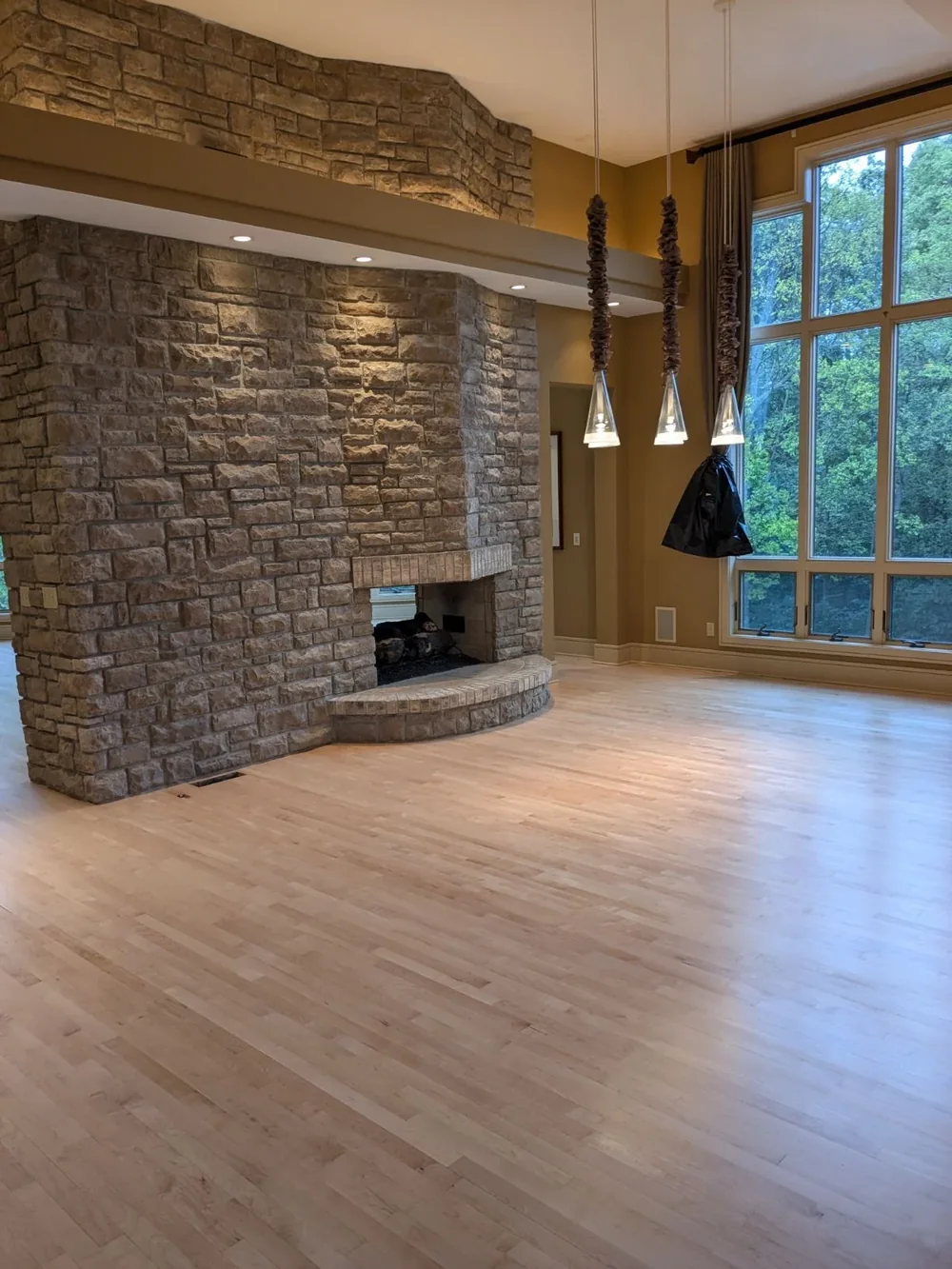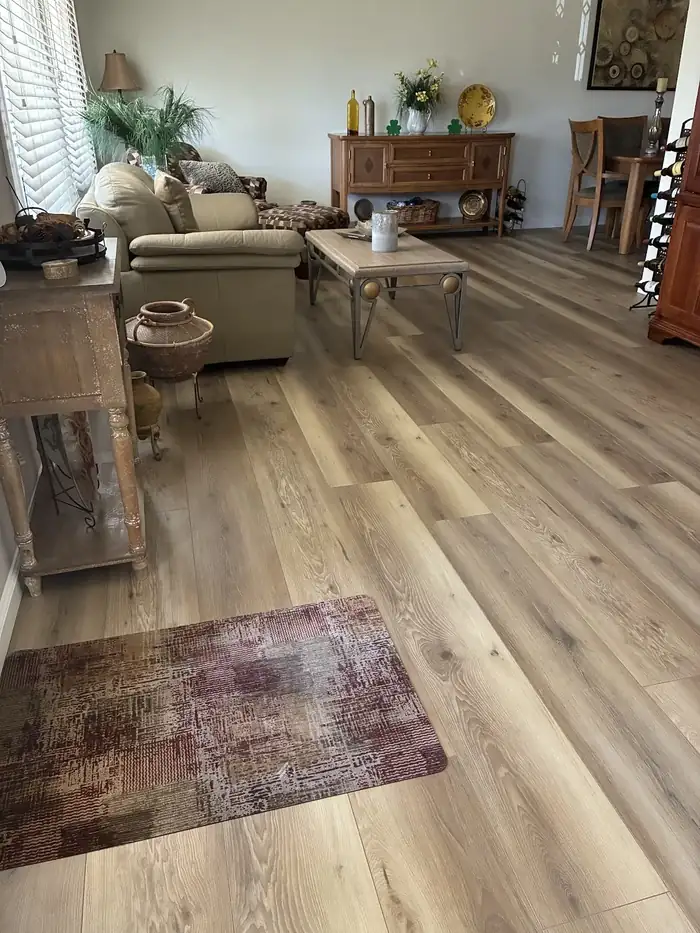

It happens in this town every week. Somebody pulls up a corner of old carpet in a city bungalow or a mid-county ranch, finds red oak strip flooring underneath, and calls us with the same question: can this be saved. Usually the answer is yes. This guide walks through what to look at before you decide, and when refinishing gives way to replacement.
Why This Keeps Happening in St. Louis
Builders here laid oak strip flooring as standard for decades. The turn of the century brick two-flats and gingerbread bungalows in St. Louis got it, the 1920s Tudors and Cape Cods in the inner ring suburbs got it, and the 1950s through 1970s ranches and split-levels across mid-county got it too. Then wall to wall carpet arrived and everybody covered it up. In a lot of houses, the carpet actually protected the wood. What you uncover is often a floor with one or two good sandings still in it, in better shape than anything on the market today.
There is a difference worth knowing between eras. Pre-war floors are often true 3/4 inch solid oak, face nailed or blind nailed over plank subfloor, and dense. Post-war ranch floors in places like Florissant and Hazelwood are usually 3/4 inch as well but were sometimes laid over plywood with less generous nailing. Both refinish beautifully. The 1970s is where you start finding thinner engineered products and parquet squares, which have different rules.
The Five Minute Test Anyone Can Do
Before you call anybody, do this. Lift a floor register out of its opening. You are now looking at the cut end of the flooring, which shows you the whole cross section. Measure from the top of the board down to the top of the tongue, that little lip sticking out of the side of the strip. That distance is your wear layer, and it is the only wood a sander can remove.
A brand new 3/4 inch floor has about 1/4 inch above the tongue. Each full sanding takes roughly 1/32 of an inch. If you have 3/32 of an inch or more, you have at least one honest refinish left, often two. If the tongue is nearly at the surface, or you can see nail heads at the edges of boards out in the middle of a room, that floor has been sanded to the end of its life and it is time to talk about new wood.
What You Will See, and What It Means
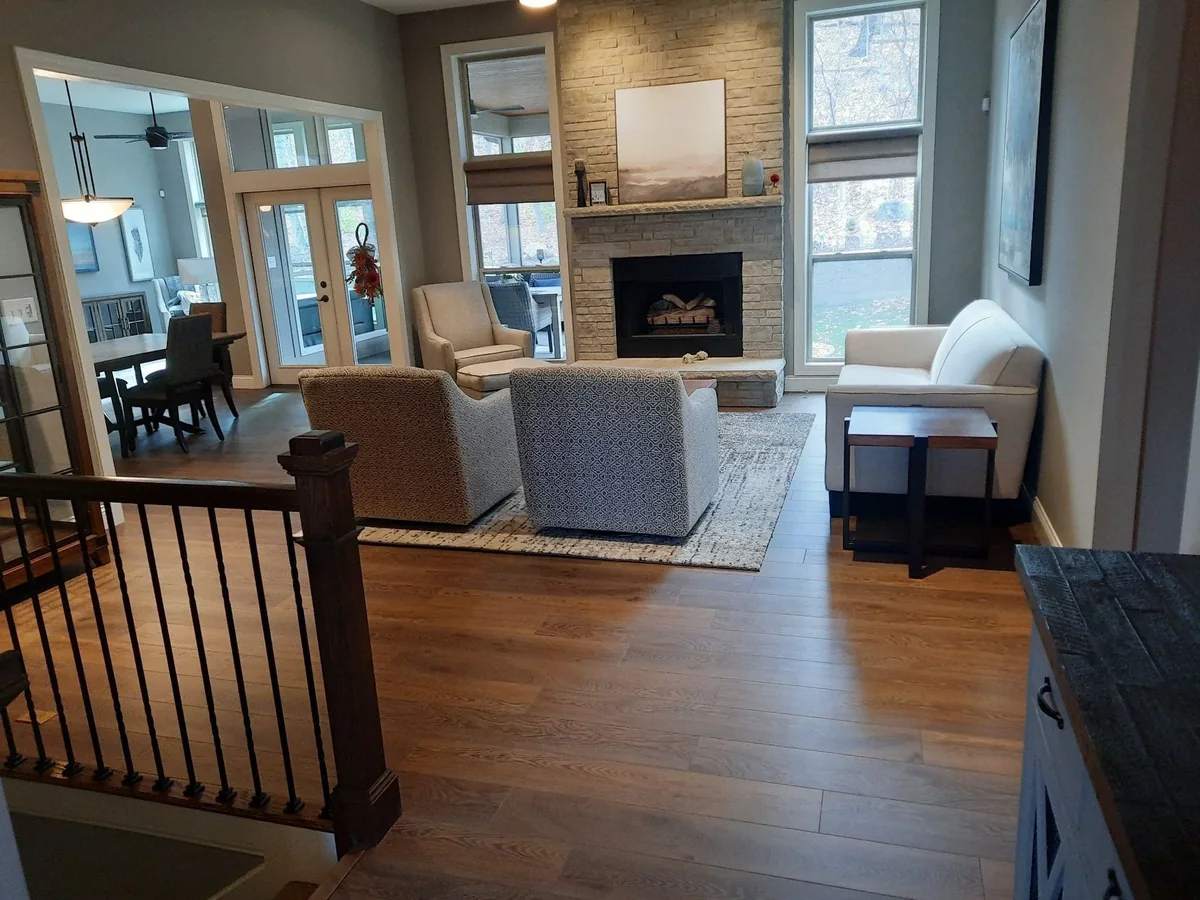
Once the carpet is out, the floor looks rough. That is normal and not a verdict. Here is how to read what you are looking at.
| What you see | What it usually is | Verdict |
|---|---|---|
| A band of small holes along every wall | Tack strip nails from the carpet install | Sands out or hides under new shoe molding |
| Rows of staples across the field | Carpet pad staples | Pulled and sanded out |
| Gray, dull boards in the walkways | Worn through finish, not worn through wood | Refinish |
| Dark, spreading stains under where a pet slept | Urine that soaked past the finish into the wood | Replace those boards, refinish the rest |
| Board edges higher than centers | Cupping from moisture under the floor | Find the moisture first, then refinish |
| Soft, spongy boards near a radiator or window | An old leak and rot in the subfloor | Replace that section |
| Nail heads visible at the board edges | The floor has already been sanded twice | Replace |
| Gaps you could lose a dime in, in January | Dry winter air, seasonal shrinkage | Normal here, refinish |
Cupping, Gaps, and Missouri Weather
Wood moves in this climate more than people expect. Summer dew points in the 70s swell boards; a winter of dry furnace air shrinks them. Gaps that open in January and close in June are the floor doing its job. Sanding a cupped floor flat in August is a mistake, because when it dries out in winter you get the opposite problem and every board edge shows a step. We check moisture with a meter before we schedule a sand, and if a floor is wet we find out why first - a basement humidity problem, a crawlspace with no vapor barrier, a slow supply line under a kitchen.
That last point is the one that saves people money. If a floor cupped because a dishwasher has been weeping for two years, refinishing without fixing the leak buys you a beautiful floor that cups again the same way. Fix the water, let the wood come back down, then sand.
Not sure what you are looking at under that carpet?
Have us come look, freeThe Answer Is Usually Both
In practice, most of these jobs are not pure refinish or pure replace. They are a patch and a refinish. We lace in new 2 1/4 inch red oak where the damage is - under a former closet wall, where a floor furnace grate used to sit, at the doorway where the kitchen vinyl stopped - weaving the new boards into the old pattern instead of cutting a square. Then everything gets sanded and finished together, and the repair disappears. Blending a kitchen into a hall so nobody can find the seam is regular work for our crew.
New wood is lighter than old wood, so a stain color does a lot of the blending. This is another reason we test stain on your actual floor. Once in a while the honest call is a fresh floor: sand-through, water damage across a whole room, or thin 1970s parquet that will not take a machine. When that happens we lay out real options, from new solid oak to engineered hardwood over a slab to luxury vinyl plank if the room takes water.
Do Not Forget the Stairs
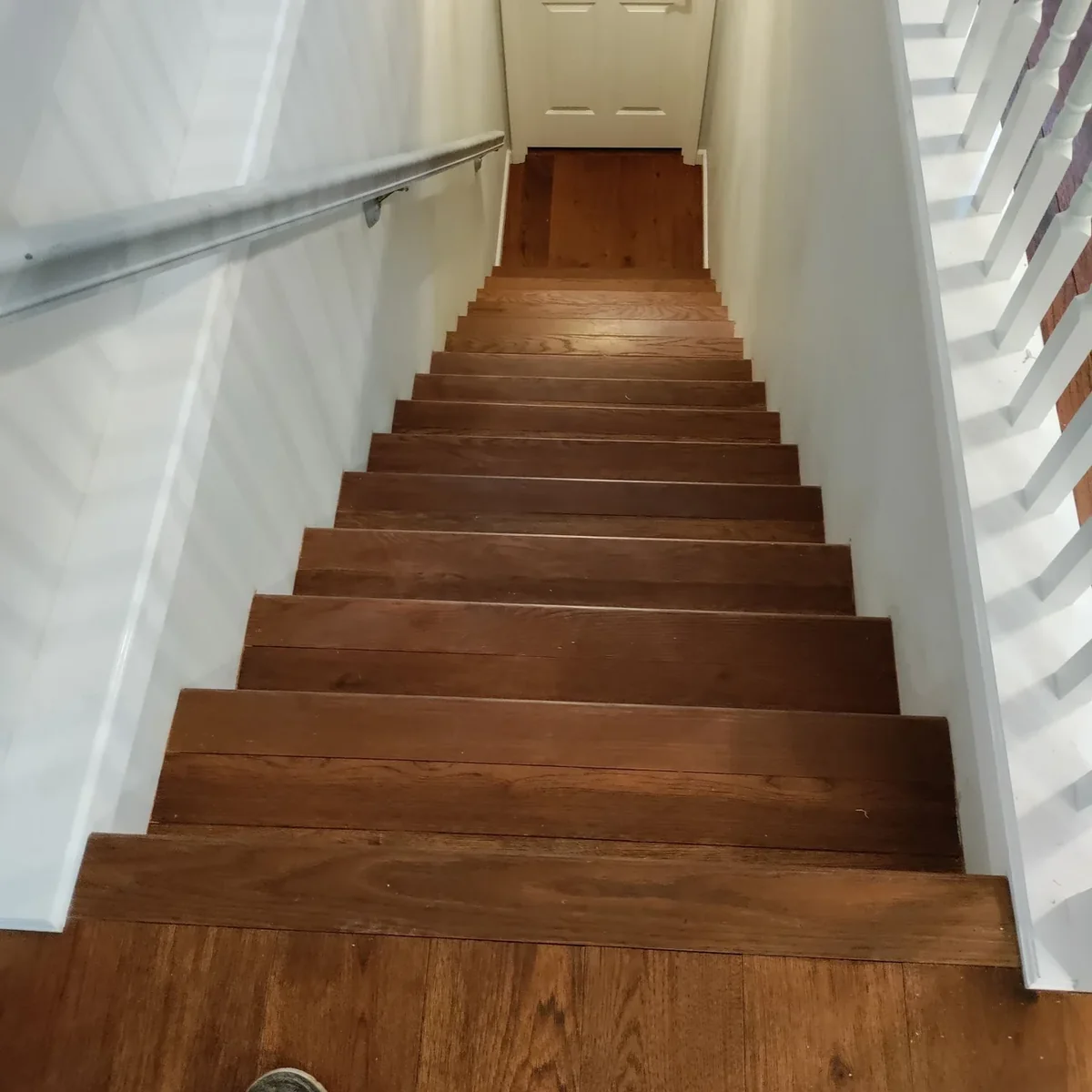
If the carpet ran up the stairs, look at the treads before you pay to recarpet them. In a lot of St. Louis homes those treads are solid oak and were never finished because nobody expected them to show. Refinished treads with painted risers is one of the best looking, best value moves in an old house. Stairs price per tread, $60 to $150 depending on material and how much return work each one needs, and you can see finished examples in our inspiration gallery.
Have Somebody Look Before You Commit
There is no charge for us to come see it. Our sales team measures the rooms, checks the wear layer, reads moisture, and tells you straight whether it is worth saving. If it is, you get a refinishing number. If parts of it are not, you get a number for the patch and the refinish together. Call (314) 897-4383 or stop by the showroom at 149 Weldon Pkwy in Maryland Heights, weekdays 8 to 5. Your floor is our mission, and we would rather save your original oak than sell you new wood you do not need.