Almost every house in this metro has a basement, plenty of them are finished, and a lot of them have taken water at least once. That combination makes basement flooring one of the most common questions we get. Here is what actually holds up down there, what fails, how to test your slab before you spend a dime, and what to do the week after a basement floods.
Why St. Louis Basements Are Harder Than Most
Two things work against us here. The first is the water. Flash flooding along the Missouri and the Meramec, spring storms that dump two inches in an hour, and old clay tile drains around century old foundations all mean water finds its way in. The second is the humidity. Summer dew points in the 70s combine with a cool slab, and moisture condenses on the concrete the same way it beads on a glass of iced tea. A basement can be bone dry in terms of leaks and still push enough vapor through the slab to ruin the wrong floor.
That is why the material question comes second. First figure out how much water and vapor your slab is dealing with, then pick a floor that can live with it.
Test the Slab Before You Buy Anything
The homeowner version of a moisture test is simple. Tape a two foot square of clear plastic sheeting to the bare concrete on all four edges, in a few spots around the basement, and leave it for 72 hours. Lift it and look. Condensation on the underside of the plastic, or a dark patch on the concrete, means your slab is passing vapor and you should stay with a fully waterproof floor and skip any product with a fiberboard core.
When we are putting down something that matters we go further with a meter or a relative humidity probe in the slab. It is also worth walking the outside of the house first. Downspouts dumping at the foundation, negative grade, and a sump pump with no battery backup cause more basement flooring failures in this town than any product defect. Fix the water before you finish the floor.
What Works, and What It Costs
| Basement option | Installed $/sq ft | How it handles water |
|---|---|---|
| Rigid core luxury vinyl plank | $5 - $10 | Waterproof plank and core; survives a wetting if it dries out |
| Porcelain or ceramic tile | $8 - $18 | Handles standing water better than anything; hard and cool underfoot |
| Carpet tile | $2.75 - $7.50 | Wet squares lift out and get replaced individually |
| Broadloom carpet with pad | $2.75 - $7.50 | Warmest option, but the pad holds water and can grow mold |
| Laminate | $4 - $8 | Fiberboard core swells and blows out; wrong choice below grade |
| Engineered hardwood | $8 - $14 | Possible over a dry, tested slab; not over one that wicks |
| Solid hardwood | $9 - $16 | Cups and buckles over concrete; we do not put it down there |
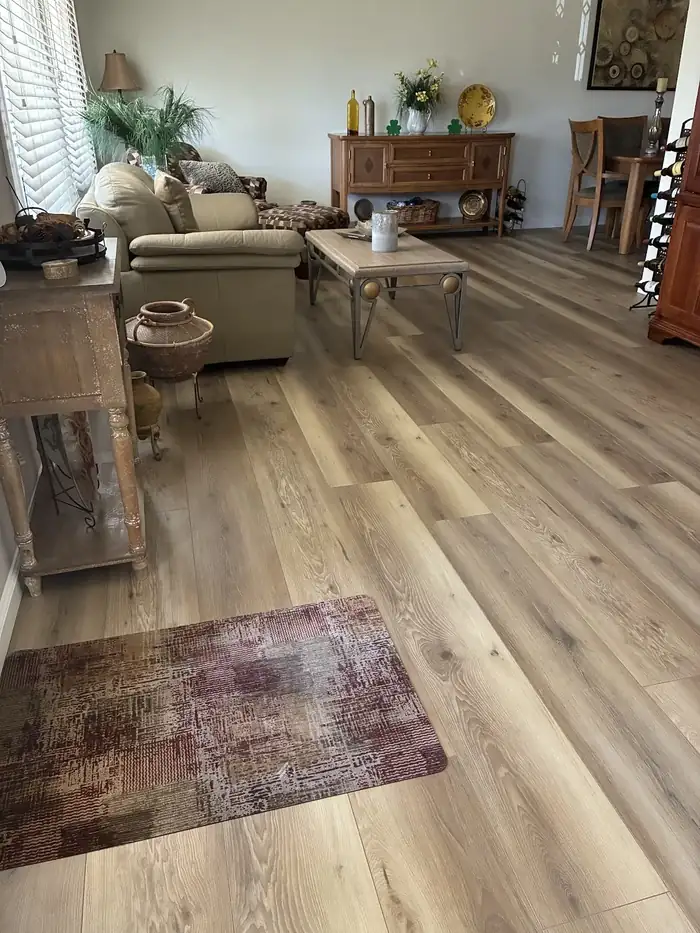
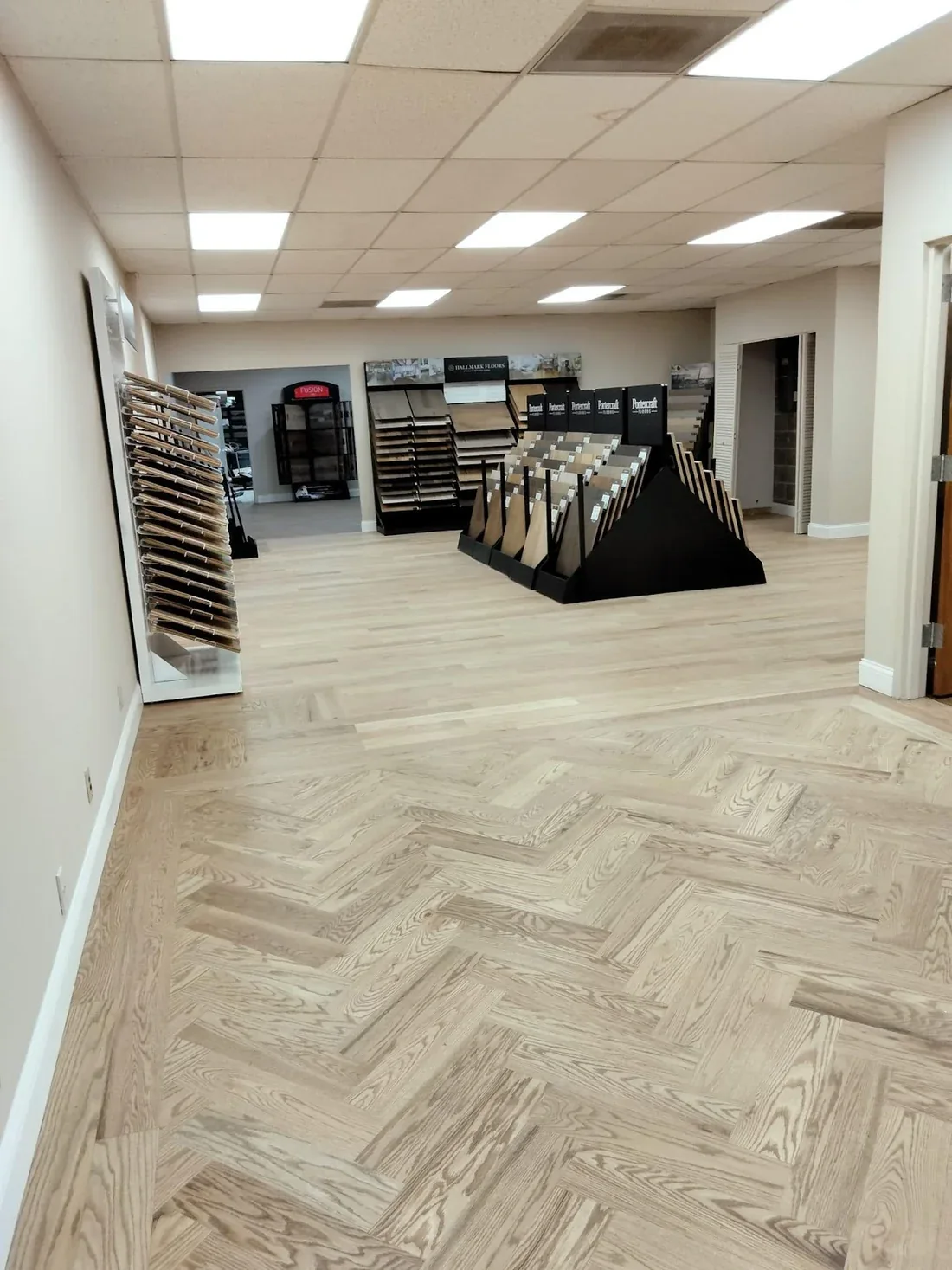
For most finished basements in Chesterfield, Ballwin and St. Charles County, rigid core LVP is the answer. It looks like wood, it is warmer and quieter than tile, it goes down floating over a flat slab, and a wet floor is an inconvenience instead of a demolition. We carry Hallmark Floors, Portercraft and Fusion products, and the sample racks in the Maryland Heights showroom let you see them in real light with the underlayment attached.
What Fails Down There
Laminate is the most common mistake we get called about. It looks like a bargain at $4 to $8, and its core is compressed wood fiber. One wet weekend and the seams swell into ridges that never go back down. Laminate is a good product in a dry upstairs bedroom or a rental, and a bad one on a slab.
Solid hardwood below grade is the other one. Concrete pushes vapor up into the boards, they swell along the edges, and by the second summer the floor is cupped or lifting off its fasteners. Broadloom carpet with a standard pad is not a failure exactly, but it is a gamble - the carpet may dry, the pad rarely does, and a pad that stayed damp for a week in a mid-county basement will smell about it for the rest of its life. If you want soft, use carpet tile squares so a wet corner is a $40 problem.
The last failure is prep. Basement slabs are rarely flat. Old trench patches where a plumber cut in a drain line, control joints, and slopes toward a floor drain all telegraph through a floating floor and open its seams. Grinding high spots and filling low ones is part of the job, and it gets quoted as prep work rather than hidden in the price.
Planning a basement, or recovering from one that took water?
Get a free basement flooring estimateAfter Your Basement Takes Water
Speed decides most of it. Mold gets going in about 48 hours, so the first two days matter more than anything you do later.
- Get standing water out and run fans and a dehumidifier hard, not the air conditioner alone.
- Pull wet pad immediately. Pad is cheap and it never really dries. Carpet itself sometimes survives if it is lifted and dried within a day or two.
- Pull baseboards and drill or cut weep holes if drywall wicked water up, so the cavity behind it can dry.
- With floating LVP, take up a run of plank at the wall so air can get underneath. Plank that stayed dry underneath usually goes back down.
- Take photos of everything before you throw anything away, for the insurance claim.
- Once it is dry, have somebody look at the subfloor and the slab before you install a new floor. We do this kind of water damage repair regularly, including a tornado damaged condo where we put down new plywood underlayment and LVP and refinished the original hardwood upstairs.
Comfort and Warmth Below Grade
A slab is cool year round in Missouri, and that is a feature in August and a nuisance in January. A few things help without giving up water resistance. Rigid core LVP with an attached pad reads noticeably warmer than tile. Area rugs over LVP or tile give you soft spots without committing the whole room to carpet. And if the basement is a real living space, ask about an uncoupling membrane under tile, which allows in-floor heat later without redoing the floor.
Keep a dehumidifier running down there through the summer regardless of what you install. Holding the basement somewhere near 50 percent relative humidity protects the floor, the framing, and everything you are storing in the corner.
Talk It Through With Us
Basements are the one room where the wrong choice shows up two years later instead of two weeks later, so it is worth getting a set of eyes on the slab first. Our sales team will measure, check moisture, look at the drainage and the sump situation, and give you one written price. We work basements all over the metro, from Ballwin to Florissant to the newer subdivisions in St. Peters. Call (314) 897-4383, come by 149 Weldon Pkwy in Maryland Heights weekdays 8 to 5, or ask about financing through Hearth and Synchrony if the project is bigger than the budget this month.